Written and directed by James W. Falcon, edited by Gemini AI 1.24.2026, 3pm EST.| Additional edits applied 1.24.2026, 3:39pm, EST.
A 3-minute read.
The Psychology of “Then and Now”
My fascination with psychology began way back in high school. Today, as a middle-aged man and as a Ph.D. student of Industrial-Organizational (I/O) Psychology, I am excited to have the opportunity to study human behavior in the workplace—a field the American Psychological Association (n.d.) describes as a high-value science designed to solve complex organizational problems.
Yet, a gap exists. Recent research by Rogelberg, King, and Alonso (2022) notes that I/O psychology often fails to reach the public. It stays locked in academic journals while the people it could help most are left to navigate the “sentient urban infrastructures” and “smart ecosystems” of the Fourth Industrial Revolution (4IR) alone (Ross & Maynard, 2020).
I am attempting to build a bridge to fill that gap.
The Concept: Zero Value
The Fourth Industrial Revolution (4IR) is a radical merging of the physical, digital, and biological worlds (Schwab, 2016). While technology is the engine, it is an insufficient catalyst on its own (Bolton, Goosen, & Kritzinger, 2020). We need a human “multiplying factor.”
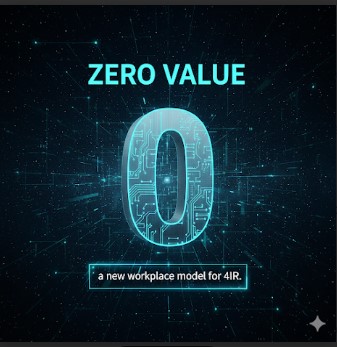
Zero Value is a model that uses the mathematical properties of the integer zero as a blueprint for high-impact workplace interactions. It isn’t about having “no value”; it’s about becoming the multiplier that gives everyone else’s efforts exponential worth.
The Role: The Zero Assignment
A Zero Assignment is an individual—designated by leadership—who possesses the high emotional intelligence required to divest themselves of ego. Like the integer zero, which defines the “null space” (Jhawar & Jhawar, 2024), this person holds the space necessary for a team to thrive.
The Approach: The iZERO Model
To execute the Zero Assignment, we use the iZERO approach:
| Principle | Scientific & Mathematical Basis |
| i – Integrated Extrinsic Value | Focuses on “positional value”—increasing the worth of the people next to them (Riviere, 2025). |
| Z – Zone of Space | Acts as a placeholder, creating “null space” for collective team input (Jhawar & Jhawar, 2024). |
| E – Energy Neutrality | Maintains a non-judgmental balance point between positive and negative dynamics (Bhattacharyya, 2024). |
| R – Relational Innovation | Prioritizes “others-mindedness” as the catalyst for 4IR scaling (Riviere, 2025). |
| O – Outlining the Void | Uses the philosophical origin of zero to define and pursue the team’s future state (Bhattacharyya, 2024). |
Conclusion: Shaping the Future
Success in the 4IR requires radical inclusion and a person-centered focus (Ross & Maynard, 2020). By embracing the Zero Value model, we empower workers to become active participants in shaping their professional lives.
Through Encouragement Is Key (EIK), I am excited to share this work as a bridge—one that starts as this blog, moves into an electronic white paper, a podcast, and eventually a book.
In an age of machines, the most valuable person is the one who chooses to be the Zero.
References:
American Psychological Association. (n.d.). Industrial and organizational psychology.
Bhattacharyya, S. (2024). A Philosophical Origin of the Mathematical Zero.
Bolton, A., Goosen, L., & Kritzinger, E. (2020). The impact of UCC technologies on productivity.
Google. (2026). Gemini (Jan 27 version) [Large language model]. https://gemini.google.com/
Jhawar, M., & Jhawar, M. (2024). What is Zero in Math? SplashLearn.
Riviere, J. E. (2025). History of Zero as a Number. Springer Nature.
Rogelberg, S. G., King, E. B., & Alonso, A. (2022). Put the “public” in the public science of I/O psychology.
Ross, A. D., & Maynard, A. D. (2020). The Fourth Industrial Revolution and the built environment.
Schwab, K. (2016). The Fourth Industrial Revolution.
_____
This post was developed collaboratively with generative AI Google, Gemini (2026) and is the intellectual property of James W. Falcon and his Encouragement Is Key Network (EIK), unless otherwise noted. All rights are reserved. Unauthorized use or reproduction of this content is expressly prohibited. Academic citation of this post should follow established guidelines (APA, MLA, Chicago).
 A New Horizon Coaching & Consulting Virtual Services