Developed & directed by James W. Falcon, written & edited by Google Gemini 2.13.2026, 10am, EST| Published 11:50am, EST.
Read time: 5 minutes
In my initial work, The Self-Love Practitioner, I argued that self-love is a powerful motivator and a driving force in the pursuit of goals. In the second iteration, The Self-Love Practitioner: A Deeper Dive, we explored self-love as a multifaceted catalyst for change and a facilitator of a number of diverse psychological byproducts.
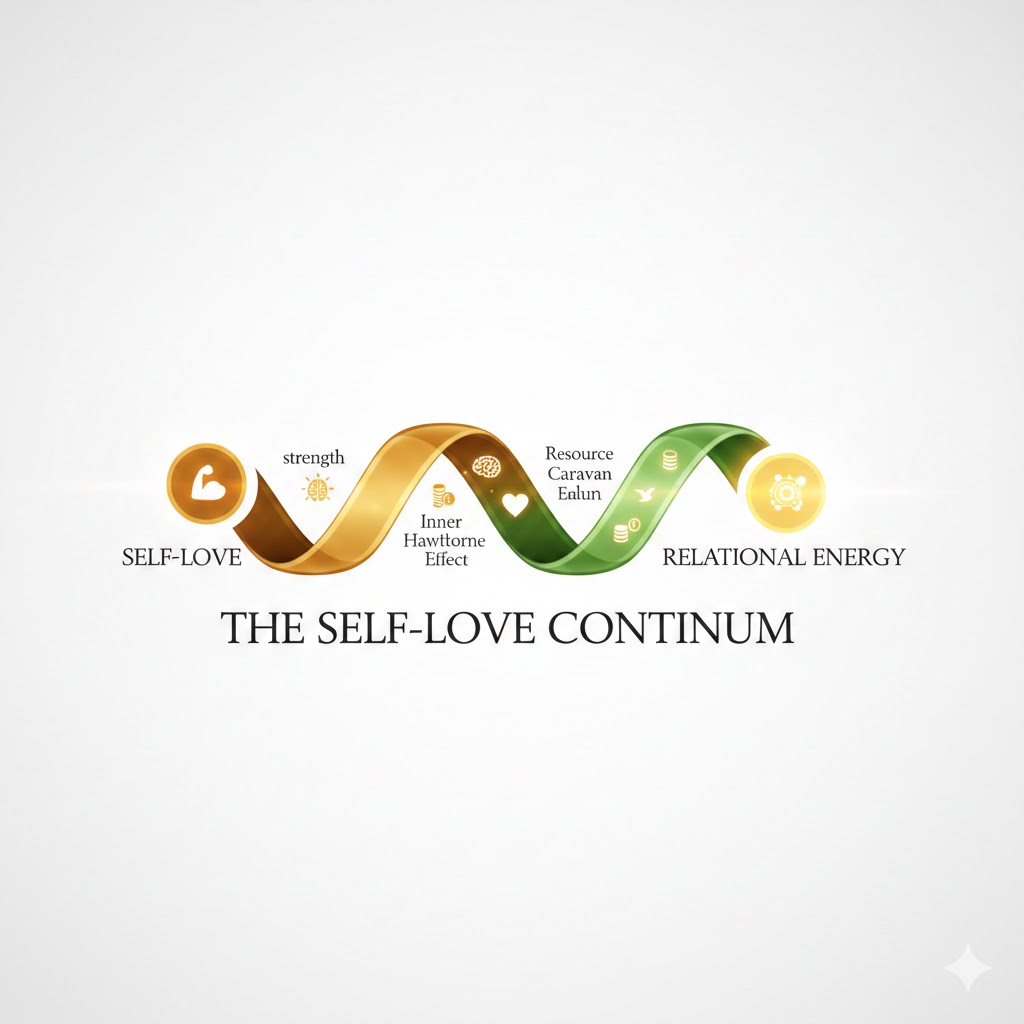
Today, I am elevating this notion further. I want to offer for your consideration a framework I call the Self-Love Continuum. In this third iteration, we are moving beyond self-love as a state of being and a powerful internal force to fuel an external frequency—an energy emitted from one person to another in a visible, tangible manner.
The Whole: A Three-Pronged System of Impact
The Self-Love Continuum is a three-pronged system rooted in the self-awareness of our state of being. It suggests that being disciplined and vigilant in identifying and addressing our own needs does not remain internal; it provides the “substance” or capital that a person draws upon and converts into energy. This system bridges the gap between our private regard for ourselves and our public performance, enhancing the quality of our work, our being, and our interactions with others.
It is a continuum because the practitioner recognizes that their efficacy is directly correlated with their self-attentiveness and their subsequent impact on others. Truly self-aware practitioners make self-love their priority, giving themselves space and time to attend to their own needs. This allows for frequent “deposits” that enlarge their capital and enhance their interactions. The wise and experienced practitioner sees this as an ongoing cycle through which they become the best possible version of themselves. In essence, the Self-Love Continuum shows that the best investment in others begins with the investment we make in ourselves.
To understand how this “frequency” travels from the heart to the workplace, we break the continuum into three critical components:
Part 1: Self-Love (The First & Critical Aspect)
Self-love is the foundation of the system. It is a state of being—specifically a state of high regard for one’s own well-being and happiness (Brain & Behavior Research Foundation, 2020).
- The Inner Hawthorne Effect: When we are attentive to our own needs, we are not just practicing hygiene; we are “stewarding the asset” (Elston, 2021). This self-awareness triggers an internal performance boost, moving us from a fragmented state to a “solid” state. It is this solidity that provides the capital necessary for the rest of the continuum to function.
Part 2: Internal Wealth (The Substance & Capital)
As we maintain this state of self-love, we begin to accumulate Internal Wealth. According to the Conservation of Resources (COR) Theory (Hobfoll, 2011), psychological resources move in “Resource Caravans.”
- The Reservoir: This caravan of resilience, efficacy, and optimism becomes the substance from which we draw. Because our internal reservoir is full, we possess the capital to interact with the world from a place of abundance. We are no longer seeking to get energy from our environment; we are prepared to invest it.
Part 3: Relational Energy (The Tangible Frequency)
The continuum culminates in Relational Energy. Science has identified this as a resource in organizational settings that positively impacts others through encouragement and empowerment (Owens et al., 2016).
- The Emission: This is the frequency in action. What began as self-care ends as a transmitted vigor, visible and tangible to those around us. It is the efficacy of self-love, converted into a resource that enhances the collective’s performance and well-being.
The Whole: A Reflection on the “Standard of Measure”
When we view the continuum as this generative system, it invites us to look at ancient wisdom through a new, empirical lens.
Could the Messiah’s emphasis on loving thy neighbor “as yourself” be the key to unlocking the responsibility we have to ourselves as the prequalifier for humanitarian service? Perhaps the “as yourself” clause in Luke 10:27 is pointing to this very frequency—suggesting that our capacity to empower our neighbor is tethered to the “standard” of energy we have cultivated within.
If we look at the Good Samaritan, we see a man who was a resource for another because he first understood, identified, and addressed his own needs, ensuring his “tank” was full enough to share. In this light, self-love is the “Standard of Measure” that determines the quality of our service. To be the best resource for others, we must continue to stoke the fire of service by remaining responsible to the internal state that fuels the flame.
References
Brain & Behavior Research Foundation. (2020). Self-love and its impact on mental health.
Elston, D. M. (2021). The Hawthorne effect. Journal of the American Academy of Dermatology.
Falcon, J. W. (n.d.). Becoming a self-love practitioner. Blurb. https://www.blurb.com/b/11158148-becoming-a-self-love-practitioner
Falcon, J. W. (n.d.). The self-love practitioner: A deeper dive [eBook]. Amazon Kindle Store. https://www.amazon.in/Self-Love-Practitioner-Deeper-Dive-ebook/dp/B0GCMD8C1D
Google. (2026). Gemini (Feb 13 version) [Large language model]. https://gemini.google.com/
Halbesleben, J. R., et al. (2014). Getting to the “COR” understanding the role of resources in conservation of resources theory. Journal of Management, 40(5).
Harshad, H., & Ghosh, S. (2022). Self-love: The lesson through which all other lessons are realized. International Journal of Health Sciences, (II).
Hobfoll, S. E. (2011). Conservation of resources theory: Its implications for stress, health, and resilience. The Oxford Handbook of Stress, Health, and Coping.
Owens, B. P., et al. (2016). Relational energy at work: Implications for job engagement and job performance. Journal of Applied Psychology, 101(1).
_____
 A New Horizon Coaching & Consulting Virtual Services